Thursday, November 17, 2011

visions


www.fssbirding.org.uk/visions.htm

Choose an inappropriate shutter speed, for example 30 seconds.
Don't worry about holding the camera absolutely steady.
Shoot when the light is poor, for example at night.
Don't worry about the subject matter, just imagine.

East Tilbury


My dad was down visiting from Scotland last weekend and we made a trip out to East Tilbury on the Thames estuary. It was so mild that I was wearing a T-shirt! Redpoll, Skylark and Meadow Pipits were on the move, but strangely no Redwing or Fieldfare. Best birds of the day were three Arctic Skuas (two chasing the Common Gulls, another drifting upstream on the rising tide), ringtail Hen Harrier, juv Marsh Harrier, 480+ Avocets, plus hundreds of Dunlin, Grey Plover and Knot, along with smaller numbers of Black-tailed and Bar-tailed Godwits.


Tuesday, November 15, 2011

Leaf Fall on the Whitebox


Birds on Beer Bottles

On his travels, my dad often brings me back beer bottles with birds depicted on the label. Here are a couple from the Allendale Brewery in Northumberland: Golden Plover & Wagtail Ale.


Monday, November 07, 2011

Hovering Starlings

Trying to capture Starlings (Sturnus vulgaris) in flight, hovering at close range, is quite difficult with a wide angle lens, even with the tame birds in the London parks. Holding bread in one hand, camera in the other, results are usually (a) bird too far away, (b) bird too close (c) good capture but wings clipped. It would be much easier with an assistant to feed the birds, allowing more concentration on them flying into the frame. Interestingly the boldest bird had been ringed - perhaps they have less fear of the human hand now?


Mute Swan: another angle

A tourist throws bread for a Mute Swan in a central London park.


Taken with the Canon 10-22mm lens.

Wednesday, November 02, 2011

Pallid Harrier, Garnock Floods, Ayrshire

Click images for larger versions. Better quality images can be found on my photography site:
www.frasersimpson-birdphotography.com


Ayrshire's first recorded Pallid Harrier was found in the Garnock Floods/Bogside area by Gordon McAdam on 27 October 2011. On site the following day was Chas Moonie, photographing birds, concealed and out of view of Gordon. Chas luckily obtained some close-range images of what he assumed was just one of the local Hen Harriers but Gordon's suspicions were confirmed when the images on Chas's camera revealed a juvenile Pallid Harrier! I made an overnight trip up from London at 2325h to Glasgow on the coach to see this cracker and add it to my Ayrshire list on Sunday night, before heading back down on Monday night. Catching a train from Glasgow to Irvine at 0800h, it’s route actually passed right through the marshes where the bird was present, minutes before the line enters Irvine. I met Lisa here before we headed up to join some local birders including Gordon, Angus, Mike and Rab. It was a grey day with some showers and the harrier only approached to about 130 metres on it closest circuit and I knew that I was only going to obtain 'record-quality' images.


These images however show the following features:

(1) A striking head/neck pattern dominated by a broad, unstreaked head-collar, ranging in colour from white on the top of the head to buff/cinnamon below on the neck/throat; contrasting with mid-brown neck bands forming a semi-collar extending from the nape down to just below eye level (in horizontal flight position); plain dark brown cheeks/ear coverts and 'eye-patch' contrasting with delicate white stripes above and below the eye and pale brown forehead.

(2) Plain, unstreaked buff/rufous underparts complete from the lower neck to the vent, continuing over all of the underwing coverts.

(3) A contrasting underwing pattern comprised of rufous coverts, dark brown secondaries with a visible pale outer band and hint of an even paler inner band; pale grey primaries with prominent dark brown barring on the lower half though with a contrasting, unbarred patch towards the primary base, separated from the under primary coverts by a denser strip of barring; in addition a distinctive pale trailing edge to all the upper and lower flight feathers apparent.

(4) Underside of the outer tail feathers relatively plain with barring barely visible.

(5) The upperwing and uppertail show less distinction from the other Circus species with the exception of the pale trailing edge on the primaries and secondaries. The white upper-tail (rump) coverts are perhaps more extensive than is typical.

The bird is still present, to 04.11.11 at least.

Sunday, October 30, 2011

Egyptian Goose brood

The Round Pond in Kensington Gardens has a very late brood of Egyptian Geese. This pair has produced three broods this year.


Fish Eye view

I used my compact Canon G12 in 'fish-eye' mode for this shot of a tourist feeding the swans in central London.

Friday, October 28, 2011

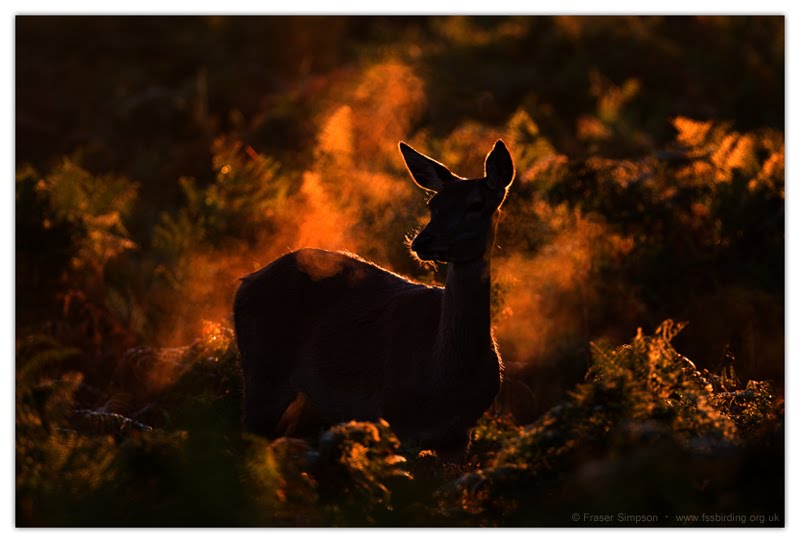
Richmond Park Deer

Some more images of Red and Fallow Deer last weekend at Richmond.


Tuesday, October 25, 2011

Grey Herons portraits: preening and exfoliating

I spent several hours with these herons, initially creeping in short stages through the grass until I had positioned them against dark woodland. After a while they always ignore me, settle down to sleep and often start preening. There has to be some trust before they begin preening as they often close their eyes or position their head in such a way that I remain out of their vision. Most of these shots are full frame, some with slight trimming of the black background.