Tuesday, June 28, 2011

Bird report for Kindrogan 10-17 June 2011

I've uploaded a bird report to my main site for Kindrogan FSC field centre 10-17 June with some excerpts and photos below: www.fssbirding.org.uk/kindrogantrip2011.htm

Click here for the Kindrogan website (Scotland’s National Centre for Excellence in Field Studies and Biodiversity Training)


Goosander Mergus merganser
Female with b/5 on the River Ardle, upstream of the field centre, on 14/06 (AW). Seven flew NW upstream over River Ardle on 13/06.


Red Grouse Lagopus scotica
One observed (by students only) on walk up Ben Vrackie on 13/06.

Ptarmigan Lagopus muta
One or more birds heard at the summit of Ben Vrackie in extremely low visibility on 13/06.


Woodcock Scolopax rusticola
One to two roding along the main drive from dusk to dawn.

Cuckoo Cuculus canorus
Singing males heard at the field centre, Straloch, Glen Brerachan, Kindrogan Hill, Tullochcurran and Moulin. Singing from 03:39 on 14/06, 03:58 on 15/06, 03:39 on 16/06.


Tree Pipit Anthus trivialis
Common in birch woodland in Glen Brerachan and Strathardle. Six singing males around the graveyard clearfell.

Dipper Cinclus cinclus
Pair present in territory at Kindrogan Bridge; adult on the tiny burn at Moulin Inn 13/06; juvenile on the River Ardle on 15/06; adult carrying food to young in the nest at Kirkmichael.


Redstart Phoenicurus phoenicurus
Two singing males in open birch slopes at the east end of Glen Brerachan on 16/6.

Wheatear Oenanthe oenanthe
Singing male on Ben Vrackie on 13/6.


Ring Ouzel Turdus torquatus
Singing male at usual site on Ben Vrackie 13/6.

Grasshopper Warbler Acrocephalus naevia
Singing male in rank heather on Moulin-Ben Vrackie trail on 13/06; around a marshy stream with very small willows.


Garden Warbler Sylvia borin
Singing males at the walled garden, front lawn, Kindrogan Bridge, curling pond and Tullochcurran. Pair carrying food for young at the walled garden on 11/06. Singing from 03:48 on 13/06, 03:26 on 14/06, 03:44 on 15/06, 03:29 on 16/06.

Blackcap Sylvia atricapilla
Better numbers than usual with 12+ singing mm between Enochdhu-Kindrogan Field Centre-Straloch. Singing from 03:56 on 14/06; 03:58 on 15/06, 03:57 on 16/06.


Wood Warbler Phylloscopus sibilatrix
Singing male holding territory all week in open spruce forest (with larch/birch edge) at the East/West Balbald all week.

Willow Warbler Phylloscopus trochilus
Common this year with a minimum of 25 singing mm around the clearfell and restock on NE side of Kindrogan Hill; 15+ singing males between Kindrogan Bridge and West Lodge (including two at the walled garden). Singing from 03:34 on 14/06, 03:49 on 15/06, 03:38 on 16/06.


Goldcrest Regulus regulus
Common in coniferous areas. Three fledged broods observed around the field centre on 11/06; 2 singing male at Straloch on 16/06. Singing from 03:23 on 14/06, 03:37 on 15/06, 03:33 on 16/06.

Spotted Flycatcher Muscicapa striata
Pairs or singles noted at the field centre (3 territories), graveyard in clearfell, Enochdhu (2), East Lodge, curling pond (2), Balnald, Davan, West Lodge, East Lodge and eastern end of Glen Brerachan. Also noted at Moulin. Singing from 03:32 on 13/06, 03:48 on 14/06, 03:54 on 16/06.


Siskin Carduelis spinus
Abundant this year. Minimum of 15 at feeders on 12/06 including a juvenile being fed by an adult. Small flocks encountered elsewhere including 20+ in graveyard clearfell.

Lesser Redpoll Carduelis cabaret
Two over the curling pond on 13/06.

Crossbill Loxia curvirostra

Four over the curling pond on 13/06; 3 over East Lodge on 15/06.


Tuesday, June 14, 2011

Chronology of the Dawn Chorus

I'm at Kindrogan FSC field centre in Perthshire in the Scottish Highlands this week on the usual Field Methods in Biology undergrad course. This morning I was up and out at 3am in time for the dawn chorus. The chronology (when song from each species is first heard) was as follows with all species singing in much the expected order before sunrise around 04:23.
03:03 Robin
03:08 Song Thrush
03:21 Blackbird
03:23 Goldcrest
03:26 Garden Warbler
03:24 Willow Warbler
03:39 Cuckoo
03:43 Chiffchaff
03:48 Spotted Flycatcher
03:54 Chaffinch
04:03 Wood Pigeon

Unusually for the first time since I began these crazy morning observations in 2003, this is the first year that no Wrens have been on territory at this site. They would be expected to kick in around 03:35.

Friday, May 27, 2011

Rumours of Cranes

From the 'Short Notes' section of No.1 of Volume 1. of Scottish Birds (Autumn 1958) published by the SOC:

Friday, May 20, 2011

PositiveNoise

The new System 7 track from their UP album - sounding great live at Ginglik last night.

Wednesday, May 18, 2011

Just joined SoundCloud

Common Nightingale (Luscinia megarhynchos) singing by fssbirding

Grey Heron brood in movie mode

Surprisingly, I have had the 7D body for about six months and hadn't tried to movie mode until now. Now I wish I had used it earlier while at Bosque del Apache. The quality is very good through the Canon 500mm f4 (with 1.4x extender here), though YouTube obviously has compressed the file so quality is reduced in the clip below.

Tuesday, May 17, 2011

The young punks of Regent's Park

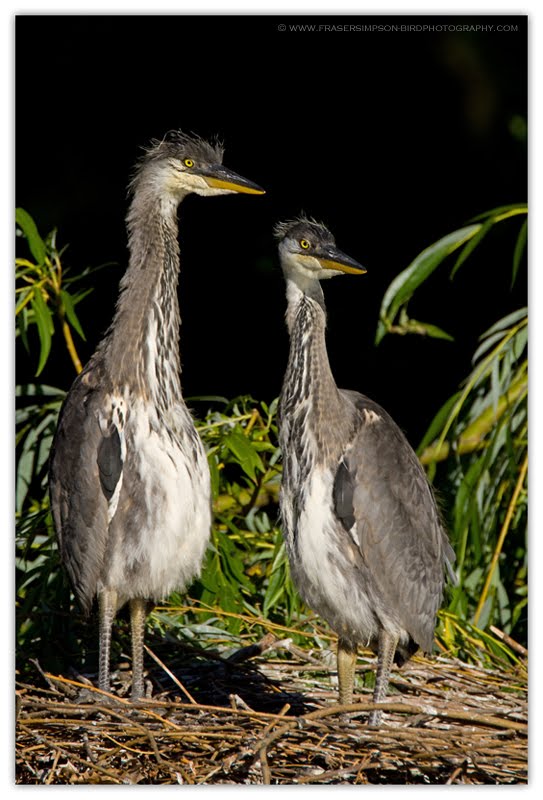
This year in the Regent's Park heronry, a pair has nested in an unusually low position in the crown of a small willow on the main island, with the added benefit (for heron-watchers at least) of clear, unrestricted views from the north side of the lake. Following Tony's blog on the development of the brood of three over the last few weeks, I decided it was time to photograph them at the weekend. There were only two feeds by the adults between 0530h and 1100h.


Wednesday, May 11, 2011

Recent sound recordings from the past year

Icterine Warbler (Hippolais icterina)


Waide Motell Campsite, Elva, Estonia 58º 23' 22.5'' N 26º 33' 29.7'' E
25 May 2010h, 0421h. Territorial song of male in secondary growth within mature mixed woodland; sonogram is an excerpt of a much longer recording.

Common Rosefinch (Carpodacus erythrinus)


Sutlepa Meri, Estonia 59º 01' 16.7'' N 23º 34' 00.5'' E
28 May 2010, 1603h. Territorial song (~8 elements in each strophe) of male high in Ash in open meadow.

Red-breasted Flycatcher (Ficedula parva)


Tooma, Endla Looduskaitseala, Estonia 58º 52' 21.4'' N 26º 15' 59.4'' E
21 May 2010, 1531h. Territorial song: single strophe preceded by two faint high-pitched notes (~7.0-8.3 kHz) from high in spruce glade with deciduous understorey.

Redwing (Turdus iliacus)


Nigula Bog, Nigula Looduskaitseala, Estonia 58º 00' 25.2'' N 24º 42' 50.8'' E
27 May 2010h 2206h. Territorial song at dusk from flooded spruce forest with larch and alder: three to four descending, fluty notes followed by complex twittering phrases, delivered at eight strophes per minute.

Common Bulbul (Pycnonotus barbatus)


Menara Gardens, Marrakech, Morocco 31° 36' 51.57" N 08° 01' 05.12" W
19 February 2011 1044h. Powerful song phrase uttered from olive grove - part of a much longer delivery.

Alpine Chough (Pyrrhocorax graculus)


Oukaïmeden, High Atlas, Morocco 31° 12' 22.38" N 07° 51' 32.30" W
13 February 2011h 0922h. Calls from a roving flock feeding in the snow - Red-billed Choughs in the background.

Monk Parakeet (Myiopsitta monachus)


Casa de Campo, Madrid, Spain 40° 24' 56.70" N 03° 45' 05.30" W
21 February 2011. Call froms a small party - very common species in this city.

European Bee-eater (Merops apiaster)


Parque Natural de Los Alcornocales, Andalucia, Spain 36° 08' 59.4" N 05° 35' 00.6" W
9 Apr 2011, 1533h. Calls from a small feeding party.

Iberian Chiffchaff (Phylloscopus ibericus)


Valle de Ojén, Parque Natural de Los Alcornocales, Andalucia, Spain
36° 08' 46.8" N 05° 34' 58.2" W 11 Apr 2011, 1209h
Territorial song from cork oak/holm oak woodland. This bird was singing with continual variation between successive strophes.

Western Bonelli's Warbler (Phylloscopus bonelli)


Valle de Ojén, Parque Natural de Los Alcornocales, Andalucia, Spain
36° 08' 46.8" N 05° 34' 58.2" W 11 Apr 2011, 1307h
Territorial song from cork oak woodland. Strophes repeated 5-6 times per minute.

Sardinian Warbler (Sylvia melanocephala)


Arroyo del Tiradero, Valle de Ojén, Andalucia, Spain 36° 08' 46.4" N 05° 35' 04.3" W
11 Apr 2011, 1337h. Territorial song from skulking male in thorny, evergreen scrub on open cork oak slopes. Fast, chattering, scratchy warblers, each strophe lasting 3-8 seconds, mostly uttered from within cover.

Sandhill Crane (Grus canadensis)


Bosque del Apache NWR, New Mexico, US 33° 51' 33.21" N 106° 52' 37.65" W
26 December 2010. Trumpeting call from bird feeding in flock.

White-crowned Sparrow (Zonotrichia leucophrys)


Bosque del Apache NWR, New Mexico, US 33°49' 59.87" N 106° 51' 27.65" W
26 December 2010 1725h. Call froms birds preparing to roost.

Blackcap (Sylvia atricapilla)


Kindrogan, Perthshire, Scotland 56° 44' 54.3'' N 03° 32' 55.1'' W
16 June 2010 0529h. Territorial song from Yews beside walled garden.

Coal Tit (Periparus ater)


Kindrogan, Perthshire, Scotland 56° 44' 54.3'' N 03° 32' 55.1'' W
16 June 2010 0704h. Territorial male singing from open larch woodland.

Wood Nuthatch (Sitta europaea)


Kensington Gardens, London, England 51° 30' 28.7" N 00° 10' 43.8" W
26 March 2011 1201h. Male singing 'fast song' from outside nest in London Plane; up to 10 strophes per minute.

Green Woodpecker (Picus viridis)


Wanstead Flats, London, England 51° 35' 31.0" N 00° 13' 37.7" W
26 March 2011 0817h. Territorial/advertising 'yaffle' from mature Sessile Oak copse; note the unusual higher-pitched second and third elements.

Black-whiskered Vireo (Vireo altiloquus)


Long Key State Park, Long Key, Florida, United States 24º 48' 49.3'' N 80º 49' 18.2'' W
5 July 2010, 0850h. Territorial song from flooded mangroves.

Florida Prairie Warbler (Dendroica discolor paludicola)


Long Key State Park, Long Key, Florida, United States 24º 48' 53.5'' N 80º 49' 22.2'' W
11 July 2010, 0819h. Calls from male feeding along the edge of mangroves.

Red-winged Blackbird (Agelaius phoeniceus)


Long Key State Park, Long Key, Florida, United States 24º 48' 50.3'' N 80º 49' 05.7'' W
5 July 2010, 0925h. Territorial/advertising song of male in hammock scrub.

Northern Cardinal (Cardinalis cardinalis)


Long Key State Park, Long Key, Florida, United States 24º 48' 45.4'' N 80º 48' 58.2'' W
5 July 2010, 0918h. Territorial/advertising song of a male in hammock scrub.

Tuesday, May 10, 2011

Marsh Frog vocalisations

This noisy chorus of Marsh Frogs Rana ridibuna (well, probably this species as the European Water Frog group is complex with much hybridisation) was recorded in southwest London at WWT’s London Wetland Centre. The species isn’t native in the British Isle though this species does add some vocal colour to the wetland habitat here.


Monday, May 09, 2011

Black Swan Art

While sound recording at the WWT London Wetland Centre last weekend, I was distracted by the snoozing pair of Black Swans (Cygnus atratus) in the collection ponds and immediately saw the potential to create some attractive images of their beautiful plumage textures.


Friday, May 06, 2011

Scenes from Zahara de los Atunes

Zahara de los Atunes is a small town on the Costa de la Luz in Cádiz province in south-west Spain. Last month, I was on a field course there which provided sightings of Northern Bald Ibis, Griffon Vulture, Booted Eagle, Black Kite, Montagu's Harrier, Kentish Plover, Audouin's Gull, Caspian Tern, Pallid Swift, Bee-eater, Calandra Lark, Red-rumped Swallow, and Blue Rock Thrush in the town and surrounding fields and hillside.

When a strong Levante (Levanter in English) is blowing, raptors and other larger migrants trying to cross the Straits from Morocco to the Gibraltar/Algerciras/Tarifa area can be forced as far west as Zahara in certain conditions, allowing raptor watching from shore-front hotel roofs!


Thursday, May 05, 2011

Cetti's Warbler, London WWT

Well it was a windy bank holiday weekend and the only species I managed to sound record was this Cetti's Warbler (Cettia cetti) in the sheltered Wildside area of the WWT London Wetland Centre.


WWT London Wetland Centre, England 51º 28' 51.48'' N 00º 14' 5.38'' E 30 April 2011
Single strophe of song burst, uttered every 3-5 minutes from waterside alder and bramble scrub.

Thursday, April 28, 2011

I like my Opal Fruits with the wrappers on


Gulls in Aberdeen are well known for cleaning up all the food detritus left by humans, even if they do get a little over-excited on occasion and enter shops to steal Nik-Naks crisps or snatch chips from unsuspecting tourists. At the weekend I observed a Herring Gull (Larus argentatus) tucking into a forgotten bag of Starburst (aka Opal Fruits), wrappers and all! Since gulls probably have limited olfactory senses they can’t enjoy the rainbow of fruit flavours anyway! ... wait, that was the catchprase for Skittles, but no doubt they’d try them too.

Wednesday, April 20, 2011

Iberian Water Frog Chorus


Well its been a while since my last post! Earlier this month I was in south-west Spain for eleven days on an annual ecological genetics field course (a 2nd year undergraduate course) based around Zahara de los Atunes, near Tarifa. One of the study sites is the Arroyo del Tiradero in Parque Natural de los Alcornocales, a beautiful mountain stream where students study mate guarding in the pond skater (or water strider) Aquarius najas. Our particular stretch is lined with alder trees and surrounded by cork oak dehesa-like habitat. Interesting bird species here include Iberian Chiffchaff, Western Bonelli's Warbler, Short-toed Treecreeper, Cirl Bunting, Firecrest and Hawfinch, while there is often a spectacular array of raptors overhead. As well as being fantastic for bird song, at least when the wind is not blowing, there is an almost constant chorus of singing Iberian Water Frogs (Rana perezi) at this time of year. The vocal output tends to fluctuate from quiet periods when just one or two individuals are singing to almost deafening (at close range at least) crescendos during communal displays involving many frogs. This is likely to be lekking behviour (Ruff and Black Grouse being good examples in birds) but it is difficult to approach these frogs to closely observe them as they either go silent, or dive underwater.


Saturday, April 02, 2011

Eurasian Crane Unison Calls

We often read of Crane vocalisations described as ‘bugling’ or ‘trumpeting’ but I recently found a paper in the Journal of Comparative Physiology by Gaunt, A.S. et al (1987) that suggests that rather than comparison with a wind instrument, a better analogy would be with a stringed instrument such as a violin. Through experiments involving surgery of the trachea, or wind-pipe (I wonder if this sort of work still occurs today?) they found that the syrinx (the avian voice box) works like the ‘strings’ resting on the ‘bridge’ of an instrument, in this case the crane’s trachea (acting as a resonator), with the vibrations transferred to the sternum (breast bone). The sound is further amplified as the sternum is connected to a system of air sacs. Looking at pictures of the anatomy of the crane trachea, I had no idea it was so coiled.


I recorded the unison calls from a pair of Eurasian Cranes (Grus grus) in Sweden last year and if you listen to the sound file and look at the sonogram you can hear the harmonic sounds produced from both sexes during display. The male utters the single, longer call (lowest, or fundamental, harmonic between 0.65 - 0.90 kHz) lasting around 0.6 seconds with the female duetting with two shorter, slightly higher-pitched calls (lowest harmonic 0.95 - 1.15 kHz) lasting around 0.15 seconds. I was in a small hide just metres away from the pair and the loudness and intensity of crane vocals at this range was amazing. Quite different is hearing a pair at long range, echoing over a northern bog when the sound becomes evocative and beautiful… and I’ll post more on this later.