Thursday, August 16, 2007

Peru day 1: Lima

I’m in Peru with work (more on that later). Arriving just after 0600 this morning I was hoping to go straight on to Tarapoto (jungle town on the eastern slope of the Andes) but had to go the Museo de Historia Natural in the city to submit a permit. A day in Lima gave me the opportunity to see some good birds, particularly on the coast at Miraflores before returning for the evening flight to Tarapoto. Around the airport were the first of the ubiquitous Pacific Doves. As the crazy taxi drive joined the formula one race circuit into the city, American Black Vultures flapped somewhere between the fog and the smog. Yesterday was apparently sunny, but today was a typical grey day in the austral winter. The birds provided the colour with Amazilia Hummingbird, Vermillion Flycatcher and Blue-gray Tanager in the grounds of the museum. A walk to the coast through the city bustle saw species like Croaking Ground Dove, Shiny Cowbird, Long-tailed Mockingbird, Southern Beardless Tyrannulet, Groove-billed Ani and Blue-and-white Swallow. Gray Gulls were abundant on coast with many seabirds passing including the occasional Peruvian Pelican. Much of the coast road was flooded following a serious earthquake, the epicentre being much further south in Ica.

Tuesday, August 14, 2007

Ayrshire Bird Report 2006

The 2006 edition of the Ayrshire Bird Report, incorporating the Ayrshire Butterfly Report, is now available priced at £4. Essential reading for anyone visiting the county in south-west Scotland, it contains the most important bird and butterfly sightings recorded last year as well as informative articles on Ayrshire's avifauna. It is published by the Ayrshire Branch of the SOC (Scottish Ornithologists' Club).

Contents:
Introduction
The Birds of the Hunterston Area 1968-1999
Skaus at Saltcoats in 2006
Analysis of Barn Owl pellets in East Ayrshire
The Kestrel in Ayrshire 2006
Sparrowhawk Breeding Details 2006
Chronological Summary
Systematic List

Recent Rarities in Ayrshire: Pectoral Sandpiper
Ayrshire Butterfly Report 2006

It can be purchased from The Bookshelf, Newmarket Str, Ayr and Church St, Troon, and Lochwinnoch RSPB Nature Reserve. Copies can also be obtained from treasurer Dick Vernon (01292 442195). Please visit the Ayrshire Birding website for further details or e-mail me.

Fraser Simpson (Editor)
August 2007


Monday, August 13, 2007

Purple Hairstreak in Currarie Glen

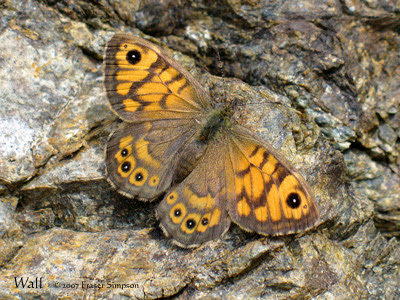
I had a BTO/SOC Atlas 2007-11 meeting in Stirling at the weekend which gave me another excuse to go to Ayrshire. Inland on Friday looked grey so Scotch Argus counts were abandoned and I checked the southern coastal areas around Lendalfoot and Ballantrae. I managed a record number of Wall Browns at Pinbain Burn with 35 counted along with 30+ Grayling. A Peacock here had a beak-shaped chunk of it's wing missing at the forewing eyespot. Further south conditions were less than ideal with wind and hazy sunshine providing only three Purple Hairstreaks on the scrubby, hillside-oaks along Shallochwreck Burn. I was looking for impressive numbers of Wall on Donald Bowie in light of the Pinbain situation, though just 23 were counted here along with 50+ Grayling. Distractions in the sea were some confiding Common and Grey Seals basking on the rocks against a backdrop of Ailsa Craig. Green-veined Whites were out in abundance in juncus marshes around Kilantringan Loch.

Saturday, August 04, 2007

Scotch Argus in Changue

Surveyed Kirstie’s Trail and Devil’s Trail at Changue for Scotch Argus. Intermittent periods of warm sunshine in the glen at Changue provided some immaculate looking Scotch Argus and it looks like emergence wasn’t particularly early here this year. Numbers could be in the hundreds in a week or two. The bridge accessing the Fairy Knowe trail is still closed so I didn’t try for Black Darter which can be common here. The pool near Kirstie’s Stone had up to three Common Hawkers plus another pair in copula nearby. One individual attempted to take a worn Meadow Brown. The Water of Gregg and Changue Burn held territorial Golden-ringed Dragonflies but the most interesting sighting was of one patrolling a wee burn less than 35cm across which runs along the footpath between High Changue and the car park. Or at least it ‘runs’ when we have a wet summer like 2007! Crossbills, Ravens and raptors were much in evidence, along with several broods of Long-tailed Tits and Goldcrests, a Jay at High Changue and Dipper and Grey Wagtail on the Water of Gregg. The wet summer seems to have provided favourable conditions for various fungi to fruit. Particularly striking was a colony of Sickener fungi under the edge of a spruce wood and a huge Fly Agaric cap, both along the Devil’s Trail.

Saturday, July 28, 2007

Stripey Heads & Frontal Shields

It was good to finally get back out with my big lens and down to the WWT Wetland Centre in London again - hadn't been there for a few months. The Wildside's Great Crested Grebe brood of three are growing up fast and a couple of Little Grebe broods were showing well, at least once everyone had left and I was about to get kicked out at closing time. Maybe I'll try Thursday night when the reserve opens until dusk.