The Viaduct Pond on Hampstead Heath


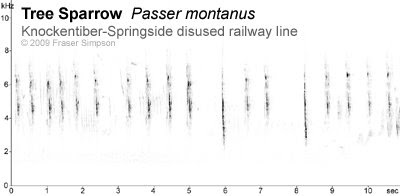

 In the sonograms above: (1) Willow Warbler - territorial song verse (it makes a a nice looking spectrograph pattern, eh?); (2) Tree Sparrow - vocalisations uttered while perched close to the nest hole; (3) Yellowhammer - territorial song verse. A neighbouring bird consistently sang without the terminal 'cheese' phrase. Another neighbour switched between a high-pitched 'cheese' ending and a low-pitched ending, one after the other at almost a 50:50 ratio; (4) Sedge Warbler - section of a much longer delivery of territorial song from a bird low in hawthorn scrub.
Incredible numbers of Painted Ladies along the south coast this afternoon - easily surpassing the county's biggest previous invasion in 1996. We stopped counting at 702! In contrast to London earlier this week when most butterflies were urgently flying north without stopping, most of today's individuals were resting and feeding on almost every available nectar source (particularly Brassicaceae, Asteraceae and Trifolium spp.) but a northward movement was still apparent in the fairly strong SE wind. Some numbers: 199 along a 500m stretch from Pinbain Burn south; 234 between Bennane Lea & Port Vad; 209 along a 500m stretch from Ballantrae Pier south; only (!) 36 at Currarie Port. Also noted from the car in every 1km home to Kilmarnock. At a rough estimate, assuming an even distribution of numbers and uniform habitat, there could have been at least 50000 along the Ayrshire coast today. Other highlights: Dingy Skipper & 21 Wall at Pinbain; 48 Wall at Bennane Lea-Port Vad; 8 Wall at Currarie, and large numbers of Silver-Y everywhere. Nine other spp inc Large Skipper, Small Heath & Small Copper.

While the news came in that southern England was about to sink under the huge number of Painted Ladies arriving, we were experiencing our own mini-plague in the north - not adult butterflies, but masses of larve of Garden Tiger and Six-spot Burnet moths! At first we saw a few hopelessly blowing across the dunes in the strong wind, somehow having lost their grip of their dune-side foodplants. Now I’m no bunny hugger (all too happy for escapee Eagle Owls to clear up the cats and small dogs) but after carefully placing the first few back in the marram grass, we soon realised this was completely futile due to the sheer numbers involved. Still, easy picking for birds that like the hairy tiger moth larvae and so it was strange that not a single Cuckoo was seen or heard on the moor, particularly in view of the number of host Meadow Pipits displaying.
We walked around 10 miles of this extensive area visiting (photos below) the remains of Forvie Kirk, Hackley Bay, Sand Loch, Cotehill Loch and the upper reaches of the Ythan and around 60 species were noted including Razorbill, Gannet, Red-throated Diver, Rock Pipit, Whimbrel, Kittwake, Fulmar and Sanderling.
On the Monday we took another bus to Blackdog for the Surf Scoter which we managed to dip, not for want of trying but due to sheer lack of optical power. My field scope was still in Ayrshire and it became clear on arrival that the flock of around 500 Common Scoters were just too far offshore to be adequately searched through using just binoculars. Later back on High Street in Old Aberdeen, we at least ticked the memorial plaque to Scottish ornithologist, William Macgillivray. Then it was back on the overnight coach from the wild North and back to the grime.


An Egyptian Vulture over the Sierra de la Plata...


 Larger versions here: www.fssbirding.org.uk/sonagrams.htm
Bank Holiday Monday yesterday so I walked into the nearest piece of 'countryside' that north London has to offer; Totteridge Valley and Darlands Lake. Anywhere around London can just be too noisy for sound recording (planes overhead every minute) but this area is good for warblers and I was interested in getting some recordings of Lesser Whitethroat vocalisations. A couple of territories were visited where the males were busy singing but no calls were heard and no females detected. The first sonogram below shows the typical song with introductory fast twitter/warble followed by the longer, dry rattle. The second is from a bird which on most occasions dropped the twitter and uttered just a longer rattling phrase. The third sonogram shows a more unusual song, one that I've not heard before. This is an extended (11 seconds), ecstatic Whitethroat/Blackcap-like warble which I recorded from a bird at a range of two metres along a pathway between two dense 2.5 to 3.0m high blackthorn (Prunus spinosa) hedgerows. It was completely unaware of my presence.


 A nearby singing Song Thrush was incorporating a lot of mimicry into its repertoire. Below are a couple of the more interesting species; the 'ke-wick' call of a female Tawny Owl and the 'laughing yaffle' of a Green Woodpecker.


Took the train up into the Lee Valley on Saturday for the Savi's Warbler at Seventy Acres Lake - only the fourth ever for the London recording area. Sleeping in (!) and the two hour journey meant I didn't arrive until mid-morning by which time it had gone quiet. This warbler has a strange cricket-like song so I decided to make a sound recording, knowing that a photograph was out the question considering its location out in the reedbed - about 80 metres from the footpath. It briefly sang around 1130h but the output from many other species including Nightingale, Whitethroat, Reed Warbler, Garden Warbler and Cetti's Warbler was still high and it was difficult to hear. I explored the rest of River Lee Country Park throughout the day, planning to return in the evening for another chance. Found around 70 species including Hobby (8+) and Marsh Harrier (imm female) and a few dragonflies including Hairy Dragonfly. Ten warbler species later I joined an assembled crowd of around 50 already listening to an evening performance of the reeler. A sound recording was a bit of a long shot but my new Sennheiser microphone managed to pick it up - ok, not a quality recording at 100 metres range, but enough to ID it on a sonogram. Continuous phrases or strophes were much shorter than the more familiar Grasshopper Warbler, typically less than 30 seconds - see the comparison below with a Gropper I recorded in Scotland a few years ago.

 Larger versions here: www.fssbirding.org.uk/sonagrams.htm


